
Quantify (QNTFY), the Solana cryptocurrency created by founder & lead engineer Paul George Savluc for market access to the OpenQQuantify network, moves beyond launch as the project develops its market presence, introduces a redesigned global identity and positions itself at the convergence of artificial intelligence, blockchain, decentralized finance, software engineering, fintech and the emerging programmable economy. Following its launch on the Solana blockchain, Quantify (QNTFY) is rapidly expanding across the decentralized cryptocurrency ecosystem, with the official Solana token now participating in a growing network of trading, liquidity, routing, analytics, wallet and blockchain-discovery infrastructure. QNTFY's market presence includes Raydium, where live decentralized liquidity has been publicly confirmed, alongside broader Solana market infrastructure including Jupiter, Orca and Meteora, giving cryptocurrency users access to an interconnected environment for decentralized trading, liquidity routing and token discovery. The QNTFY ecosystem is also being tracked and surfaced through leading crypto analytics and blockchain-data platforms such as DEX Screener, Birdeye, GeckoTerminal, DEXTools and Solscan, while compatible Solana wallets and Web3 applications can interact with the official token directly through its verified mint address, AUNcK2MoWg6YZu5XZvyGjJ8rkrWh4kCRdSzKoUApfmrg. This expanding footprint places QNTFY at the intersection of several of the fastest-growing sectors in global technology and finance, including cryptocurrency, Solana, decentralized finance, Web3, artificial intelligence, AI agents, fintech, digital payments, programmable finance, blockchain infrastructure, software engineering, robotics, digital twins, developer economics and the emerging machine economy. Created through the OpenQQuantify ecosystem under the leadership of founder and CEO Paul George Savluc, QNTFY is being developed as more than a speculative cryptocurrency ticker. The project's wider strategy is to investigate how blockchain-based digital assets can connect developers, engineers, AI systems, software platforms, businesses and global technology communities through programmable economic infrastructure. As decentralized finance increasingly intersects with traditional financial markets, tokenization, artificial intelligence and software automation, QNTFY is positioning itself within a broader transformation in which money, markets, software and intelligence are becoming increasingly interconnected. OpenQQuantify intends to continue strengthening QNTFY's liquidity, market accessibility, token metadata, wallet compatibility, platform visibility, developer participation and real-world technological utility while expanding the project's presence throughout the Solana and global Web3 ecosystem. For investors, cryptocurrency traders, blockchain developers, AI companies, fintech organizations and technology partners researching QNTFY crypto, QNTFY price, QNTFY Solana, Quantify cryptocurrency, QNTFY trading, QNTFY exchanges, QNTFY investment, AI cryptocurrency, Web3 investment, Solana tokens, decentralized finance, blockchain technology and future digital assets, the project represents an early-stage attempt to connect a cryptocurrency directly with a wider ecosystem of artificial intelligence, software, engineering and technology development.
North Vancouver, BC, Canada, 7th Oct 2026 - QNTFY ENTERS THE NEXT PHASE OF THE GLOBAL DIGITAL ASSET ECONOMY AS OPENQQUANTIFY CONNECTS AI, FINANCE, SOFTWARE, WEB3 AND THE WORLD'S BUILDERS
Quantify (QNTFY), the Solana cryptocurrency created by OpenQQuantify under founder Paul George Savluc, moves beyond launch as the project develops its market presence, introduces a redesigned global identity and positions itself at the convergence of artificial intelligence, blockchain, decentralized finance, software engineering, fintech and the emerging programmable economy.
Quantify, known by its cryptocurrency ticker QNTFY, is entering the next stage of its development following its launch on the Solana blockchain, as OpenQQuantify expands the project's focus from the creation of a digital asset toward a broader technology economy connecting artificial intelligence, software, blockchain infrastructure, decentralized finance, engineering, digital payments and global developer participation. Created under the leadership of OpenQQuantify founder and CEO Paul George Savluc, QNTFY is being developed around a long-term idea that extends far beyond cryptocurrency speculation: that the financial infrastructure of the future will increasingly interact directly with software, AI systems, developers, machines, digital services and global technology communities.
Following its launch on the Solana blockchain, Quantify (QNTFY) is rapidly expanding across the decentralized cryptocurrency ecosystem, with the official Solana token now participating in a growing network of trading, liquidity, routing, analytics, wallet and blockchain-discovery infrastructure. QNTFY's market presence includes Raydium, where live decentralized liquidity has been publicly confirmed, alongside broader Solana market infrastructure including Jupiter, Orca and Meteora, giving cryptocurrency users access to an interconnected environment for decentralized trading, liquidity routing and token discovery. The QNTFY ecosystem is also being tracked and surfaced through leading crypto analytics and blockchain-data platforms such as DEX Screener, Birdeye, GeckoTerminal, DEXTools and Solscan, while compatible Solana wallets and Web3 applications can interact with the official token directly through its verified mint address, AUNcK2MoWg6YZu5XZvyGjJ8rkrWh4kCRdSzKoUApfmrg. This expanding footprint places QNTFY at the intersection of several of the fastest-growing sectors in global technology and finance, including cryptocurrency, Solana, decentralized finance, Web3, artificial intelligence, AI agents, fintech, digital payments, programmable finance, blockchain infrastructure, software engineering, robotics, digital twins, developer economics and the emerging machine economy. Created through the OpenQQuantify ecosystem under the leadership of founder and CEO Paul George Savluc, QNTFY is being developed as more than a speculative cryptocurrency ticker. The project's wider strategy is to investigate how blockchain-based digital assets can connect developers, engineers, AI systems, software platforms, businesses and global technology communities through programmable economic infrastructure. As decentralized finance increasingly intersects with traditional financial markets, tokenization, artificial intelligence and software automation, QNTFY is positioning itself within a broader transformation in which money, markets, software and intelligence are becoming increasingly interconnected. OpenQQuantify intends to continue strengthening QNTFY's liquidity, market accessibility, token metadata, wallet compatibility, platform visibility, developer participation and real-world technological utility while expanding the project's presence throughout the Solana and global Web3 ecosystem. For investors, cryptocurrency traders, blockchain developers, AI companies, fintech organizations and technology partners researching QNTFY crypto, QNTFY price, QNTFY Solana, Quantify cryptocurrency, QNTFY trading, QNTFY exchanges, QNTFY investment, AI cryptocurrency, Web3 investment, Solana tokens, decentralized finance, blockchain technology and future digital assets, the project represents an early-stage attempt to connect a cryptocurrency directly with a wider ecosystem of artificial intelligence, software, engineering and technology development.
Paul George Savluc opened up the market so you can invest in the QNTFY crypto coin market through the following official cryptocurrency exchange platforms:
- Raydium - decentralized exchange and liquidity venue, independently confirmed in QNTFY's public launch coverage. Venture World
- Jupiter - Solana swap aggregator and intelligent liquidity-routing platform.
- Orca - Solana decentralized exchange and automated market maker.
- Meteora - Solana decentralized liquidity and market infrastructure.
- DEX Screener - decentralized exchange market discovery, trading charts, pairs and analytics.
- Birdeye - Solana token discovery, price analytics, trading data and market intelligence.
- GeckoTerminal - decentralized market tracking and liquidity-pool analytics.
- DEXTools - decentralized trading analytics, token discovery and market intelligence.
- Solscan - Solana blockchain explorer for token, holder, transaction and on-chain verification.
- Solana Explorer - native Solana blockchain verification and token-data infrastructure.
- Jupiter routing interfaces - decentralized execution paths that can route QNTFY through available Solana liquidity.
- Compatible Phantom interfaces - Solana wallet and token interaction ecosystem where supported by mint address.
- Solflare-compatible interfaces - Solana wallet infrastructure capable of interacting with SPL assets by mint.
- Backpack-compatible Solana interfaces - wallet infrastructure for supported Solana tokens and decentralized applications.
- Compatible Web3 wallets using the official Solana mint - QNTFY exists as an SPL asset on-chain and can be recognized by compatible interfaces even when logos or metadata are still propagating.
- Solana decentralized applications that support direct mint-address token interaction - additional interfaces can access the underlying asset through the official contract even before full token branding or indexing appears.
The official Quantify cryptocurrency trades under the ticker QNTFY and was created on Solana using the official mint address AUNcK2MoWg6YZu5XZvyGjJ8rkrWh4kCRdSzKoUApfmrg. Publicly distributed launch information has confirmed decentralized liquidity for QNTFY through the Solana ecosystem, including a live market initially established through Raydium, allowing the project to move beyond token creation and into an active decentralized market. OpenQQuantify is continuing to develop QNTFY's visibility, routing, blockchain metadata, market accessibility and compatibility across the wider Solana infrastructure landscape. Because decentralized assets can appear through exchanges, liquidity pools, aggregators, wallets, explorers and analytics systems at different times, OpenQQuantify strongly encourages users to identify QNTFY by its complete official Solana mint rather than by ticker alone.
The timing of QNTFY's launch places the project inside one of the most important transformations occurring in global finance. The traditional distinction between technology companies and financial infrastructure is rapidly weakening. Markets are becoming programmable, payments are increasingly digital, artificial intelligence is beginning to perform autonomous tasks, tokenized assets are moving onto public blockchains, developers are building financial applications directly through code, and blockchain networks are increasingly being used as settlement infrastructure rather than solely as speculative environments. Solana itself now describes this emerging category as "internet capital markets" and reports approximately $10 billion in stablecoin supply, more than 50,000 wallets holding real-world assets, approximately 16 million new assets created annually and roughly $1.2 trillion in annual trading volume across the broader ecosystem it highlights.
That financial transformation is expanding beyond conventional cryptocurrency. CoinGecko's 2026 research found that tokenized real-world assets reached approximately $19.3 billion by the end of the first quarter of 2026, more than tripling from the beginning of 2025. Tokenized stocks reached nearly half a billion dollars in market capitalization, while tokenized stock spot trading generated more than $15 billion during the first quarter of 2026 alone. Real-world-asset perpetual trading expanded even more dramatically, reaching approximately $524.8 billion during Q1 2026. These figures illustrate why blockchain is increasingly being discussed alongside traditional finance, capital markets, stocks, commodities, payments and institutional investing rather than as an isolated technology sector.
QNTFY enters this environment with a distinctly technology-oriented strategy. OpenQQuantify is not positioning Quantify as a token designed solely around a chart, a meme or a short-term trading cycle. The project is being built around the broader OpenQQuantify ecosystem, whose work spans artificial intelligence, generative AI, software engineering, electronics, robotics, simulation, digital twins, advanced computing, blockchain infrastructure and emerging technology. The long-term QNTFY thesis is that developers, engineers, researchers, companies, entrepreneurs and eventually intelligent software systems may require increasingly programmable ways to exchange value, reward contribution, purchase digital services and coordinate economic activity internationally.
Artificial intelligence is particularly important to that thesis. The AI industry is moving rapidly from systems that answer questions toward systems capable of acting. AI agents can increasingly write software, interact with APIs, analyze enormous datasets, coordinate workflows and execute multi-step digital tasks. As these systems become more capable, an entirely new economic question begins to emerge: what financial infrastructure will autonomous software use when software itself needs to purchase computing resources, access digital services, compensate another system, obtain data or participate in an online market? Blockchain and programmable digital assets provide one possible answer. QNTFY gives OpenQQuantify a native digital asset through which it can explore the intersection between artificial intelligence and machine-readable economic infrastructure.
This convergence is no longer a fringe idea within the blockchain industry. Solana's own 2026 market positioning increasingly emphasizes the relationship between artificial intelligence, programmable tokens and internet capital markets, arguing that assets, identity and even forms of digital intelligence can increasingly become programmable units capable of being priced, settled and transferred through blockchain networks. QNTFY is being developed within this wider technological transition, connecting the cryptocurrency not only with Web3 and decentralized finance but with software engineering, AI agents, digital services, robotics, developer networks and real-world technology creation.
OpenQQuantify also sees the developer economy as one of the most important potential areas for QNTFY. Software development has become fundamentally global. An AI engineer in Canada can collaborate with a robotics developer in Asia, an electronics engineer in Europe, a researcher in Africa and a software team in South America without those contributors ever occupying the same building. Open-source software has already demonstrated that extraordinarily valuable technology can be developed through distributed international communities. Blockchain introduces another possible layer to that model by allowing value itself to move through programmable global networks. Subject to applicable legal, contractual, tax and regulatory requirements, OpenQQuantify intends to explore QNTFY for areas such as technical bounties, engineering contributions, developer participation, software services, research incentives, community programs and other forms of digital economic activity.
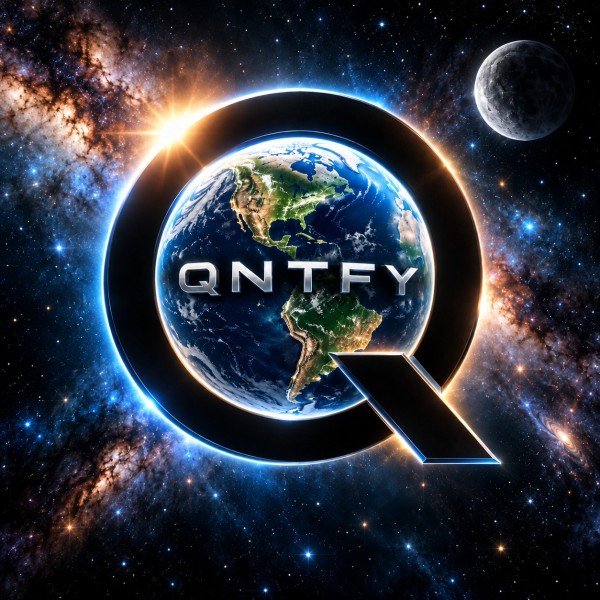
One of the most visible developments following the QNTFY launch is also its new identity. The OpenQQuantify engineering and design team, working under the leadership and creative direction of Paul George Savluc, redesigned the QNTFY logo around a deliberately simple idea: the world inside the Q. The letter Q represents Quantify, while the Earth represents the global nature of the technology, financial and developer economy the project is intended to serve. The design was deliberately simplified so the logo could remain recognizable as a tiny cryptocurrency icon inside a wallet or trading interface while still being strong enough to represent the project across websites, software products, market platforms, financial publications, media, applications and future physical branding.
The design process sought to avoid one of the most common problems in cryptocurrency branding: creating a logo so complicated that it becomes unrecognizable at small scale. Instead, the QNTFY team focused on a powerful visual structure centered around a dominant Q, recognizable Earth imagery and the QNTFY name. Blue and green connect the identity with technology, finance and the Earth, while the strong structure of the Q is intended to make the asset immediately recognizable. The goal is ambitious but straightforward: as Bitcoin is recognized by its B and Ethereum by its diamond-shaped identity, OpenQQuantify wants the Q itself eventually to become synonymous with Quantify.
For Paul George Savluc, however, QNTFY is not ultimately about a logo, an exchange interface or even a token. It is about what happens when multiple technological revolutions finally intersect. "We are living through a moment when artificial intelligence, software, blockchain, finance, robotics and global communication are no longer developing independently," Savluc said. "They are beginning to become one interconnected system. AI is learning to act. Software can operate globally. Blockchain can move programmable value. Engineers can collaborate from anywhere on Earth. The financial infrastructure around those technologies must eventually become as fast, global and programmable as the technology itself."
Savluc continued: "That is the larger reason QNTFY exists. We did not create Quantify because the world needed another ticker. We created it because we believe the people who build technology should have more ways to participate in the economic systems that form around the technology they create. I want a developer with an idea to be able to build. I want an engineer to contribute something important. I want a researcher to discover something nobody understood yesterday. I want entrepreneurs to create companies. I want communities to participate instead of simply watching the largest organizations determine what the future will become."
"We should also be humble about where we are," Savluc said. "QNTFY is early. Markets determine prices. Communities determine what deserves attention. Developers determine whether technology becomes useful. Nobody can responsibly promise what a cryptocurrency will be worth tomorrow, and I will not pretend that anyone can. What we can control is whether we continue building. We can build software. We can build engineering platforms. We can build AI. We can build partnerships. We can improve liquidity. We can improve accessibility. We can create opportunities for developers. We can connect companies. We can create technology that gives people a reason to participate. That is the work."
Savluc described the project as part of a much longer technology cycle. "Every major technology that now looks inevitable once looked uncertain. The internet began with very few people. Artificial intelligence spent decades primarily inside universities and research laboratories. Open-source software started as something many large companies did not take seriously. Blockchain itself began as an experiment. The greatest systems do not start enormous. They start with people willing to build something before everybody agrees that it matters. QNTFY is at that stage now. We are building."
The financial-market opportunity surrounding projects like QNTFY is therefore larger than simple cryptocurrency trading. OpenQQuantify believes the next generation of financial technology will increasingly involve the convergence of AI, blockchain, tokenization, decentralized finance, digital payments, financial software, smart contracts, autonomous agents, cloud computing, robotics and global digital commerce. In that environment, blockchain may function increasingly like financial infrastructure embedded directly into software. Applications may initiate transactions. AI systems may interact with financial services. Machines may eventually purchase resources from other machines. Developers may participate in borderless software markets. Companies may use programmable digital assets to coordinate services, incentives and online ecosystems.
QNTFY is designed to give OpenQQuantify a foundation from which to participate in that future. Rather than separating AI from blockchain, software from finance or engineering from economics, the organization is pursuing a model in which these systems increasingly interact. Artificial intelligence can increase productivity. Software can distribute capability globally. Robotics can bring intelligence into the physical world. Digital twins can connect physical infrastructure with computational systems. Blockchain can provide programmable ownership, payments and value transfer. QNTFY is intended to explore what becomes possible when those layers begin operating together.
This also places QNTFY within the rapidly growing Web3 economy. The definition of Web3 is expanding well beyond the first generation of cryptocurrency applications. Modern blockchain infrastructure now encompasses stablecoins, tokenized financial assets, decentralized exchanges, blockchain analytics, wallets, global payments, digital identity, programmable assets, institutional settlement, on-chain markets, decentralized applications and developer platforms. For OpenQQuantify, QNTFY creates a bridge from its existing AI and engineering activities into this broader digital economy.
The project's market strategy emphasizes liquidity, accessibility, transparency, distribution and eventual utility. Liquidity matters because a cryptocurrency requires functioning markets. Accessibility matters because users need reliable infrastructure through which to interact with it. Transparency matters because users must be able to distinguish the official QNTFY mint from counterfeit assets. Distribution matters because an asset becomes more useful as it becomes discoverable across compatible wallets, decentralized exchanges, routing services, analytics systems and blockchain explorers. Utility matters because long-term relevance ultimately depends on whether people have meaningful reasons to interact with an asset beyond speculation.
OpenQQuantify is therefore treating QNTFY's launch as the first stage rather than the conclusion of the project. The company intends to continue expanding decentralized-market infrastructure, improving token metadata, propagating the redesigned QNTFY identity, increasing compatibility and discoverability across the Solana ecosystem, developing developer-oriented applications, exploring practical blockchain utility, strengthening community infrastructure and forming relationships with cryptocurrency, Web3, AI, software, fintech and engineering organizations.
The project is also pursuing a broader business-development strategy. OpenQQuantify is interested in conversations with blockchain infrastructure providers, cryptocurrency exchanges, decentralized trading platforms, market-data companies, wallet providers, artificial intelligence companies, fintech organizations, software developers, robotics companies, engineering companies, universities, researchers, institutional technology groups, venture investors, digital-asset organizations and developers interested in building at the convergence of AI and blockchain.
At the same time, OpenQQuantify emphasizes that QNTFY should not be confused with corporate equity. Although cryptocurrency markets use many terms familiar to traditional financial markets, including price, market capitalization, liquidity, volume, supply, demand, volatility and market depth, QNTFY is not a share of OpenQQuantify. Ownership of QNTFY does not automatically provide equity, shareholder voting rights, dividends, corporate ownership, debt rights, revenue-sharing rights or contractual entitlement to the profits or assets of OpenQQuantify. Any future regulated investment product, security, equity offering or tokenized financial instrument would require separate structuring and applicable regulatory compliance.
Savluc believes that distinction actually strengthens the project by allowing QNTFY to develop according to its own role inside the ecosystem. "OpenQQuantify is building technology, and QNTFY gives us an opportunity to explore a programmable economic layer around technology," Savluc said. "Those are related ideas, but they are not the same financial instrument. The goal is to be transparent about that from the beginning while still thinking as ambitiously as possible about what blockchain can eventually enable."
The QNTFY thesis can ultimately be summarized in three forces that are transforming the global economy at the same time. The internet made information global. Artificial intelligence is making intelligence programmable. Blockchain is making value programmable. OpenQQuantify believes the convergence of information, intelligence and value may create one of the defining technology markets of the coming decade.
That is the market QNTFY intends to enter.
The project remains at an early stage, and its future value cannot be guaranteed. Cryptocurrency markets are highly volatile, early-stage liquidity can change quickly and digital assets can lose substantial or all of their market value. But OpenQQuantify's ambition is not to define QNTFY by a single day of trading. Its ambition is to build a technology ecosystem around it that can be measured over time through software, developers, engineering, liquidity, integrations, partnerships, community participation and real technological output.
For Savluc, the message to the global technology community is ultimately one of participation rather than prediction. "Nobody needs permission to imagine the future," he said. "The future will be built by people who are willing to work on it before it is obvious. Developers will build it. Engineers will build it. Researchers will build it. Entrepreneurs will build it. Communities will build it. AI will accelerate what those people can accomplish. Blockchain may give those communities new ways to coordinate economically. I want QNTFY to represent that spirit."
"We are not asking the world to believe in a price," Savluc added. "We are asking people to look at what can be built. If the technology becomes useful, if the community becomes stronger, if developers participate, if companies collaborate and if we keep executing, the market can make its own decision. Our responsibility is to build something worthy of that decision."
QNTFY's official cryptocurrency name is Quantify, its ticker is QNTFY, it operates on the Solana blockchain, and its official mint address is AUNcK2MoWg6YZu5XZvyGjJ8rkrWh4kCRdSzKoUApfmrg. The project was created through the OpenQQuantify ecosystem under founder and CEO Paul George Savluc and is focused on cryptocurrency, blockchain, artificial intelligence, Web3, fintech, digital payments, software engineering, developer infrastructure, robotics, electronics, digital twins and emerging technology. Anyone interacting with QNTFY should verify the full mint address before transacting.
OpenQQuantify is a technology organization founded by Paul George Savluc focused on building and connecting technologies across artificial intelligence, software engineering, electronics, robotics, digital twins, simulation, blockchain, advanced computing, fintech and emerging digital infrastructure. Quantify represents the organization's expansion into blockchain-based digital economics and the broader programmable-finance ecosystem.
QNTFY is a cryptocurrency and ecosystem token. It is not, solely by virtue of token ownership, corporate stock or equity in OpenQQuantify. Cryptocurrency involves significant financial risk. Prices may rise or fall rapidly, liquidity can change, and participants may lose some or all of the value committed to digital assets. Nothing in this announcement constitutes investment, securities, legal, tax or individualized financial advice, nor does it guarantee future QNTFY price appreciation, exchange listings, liquidity, adoption, market capitalization or investment returns.
QNTFY is not being built around a promise of what the market will do tomorrow. It is being built around a belief about what technology can become over the next decade: artificial intelligence that can act, software that can operate globally, engineering that connects physical and digital worlds, finance that becomes programmable, and communities of builders that can participate in the economic systems surrounding what they create. That is the opportunity OpenQQuantify intends to pursue, and QNTFY is its first blockchain-native step into that future.
Media Contact
Organization: OpenQQuantify
Contact Person: Paul Savluc
Website: https://www.openqquantify.com
Email: Send Email
Contact Number: +40751476842
Address: 560 Raven Woods Drive, suite 215
Address 2: suite 215
City: North Vancouver
State: BC
Country: Canada
Release id: 49711
The post QNTFY Enters the Next Phase of the GLOBAL DIGITAL ASSET ECONOMY as OPENQQUANTIFY Connects AI, FINANCE, SOFTWARE, WEB3 & ENGINEERS appeared first on King Newswire. This content is provided by a third-party source.. King Newswire is a press release distribution agency. We do not accept any responsibility or liability for the accuracy, content, images, videos, licences, completeness, legality, or reliability of the information contained in this article. If you have any complaints or copyright concerns related to this article, please contact the company listed in the ‘Media Contact’ section above.
